Ask most people whether a big, bold wall mural belongs in a small room and they’ll say no. Yet mural wallpaper for small rooms is one of the fastest growing decor searches of the year, and for good reason. A single scenic wall works like a window into another place, and that sense of depth can make a compact room feel larger, not smaller.
The difference between a mural that opens a room up and one that overwhelms it comes down to a handful of choices. This guide covers the do’s and don’ts for mural wallpaper for small rooms, from scale and color to placement and installation.
Why Murals Are Trending Right Now
After years of plain white walls, people want rooms with personality, and a mural delivers it in one move. Instead of buying lots of small decor pieces, one large image does the work. A mural has always been about turning a wall into a scene, and modern printed and peel-and-stick versions have made mural wallpaper for small rooms affordable and far less permanent than painting one by hand.
What Counts as Mural Wallpaper
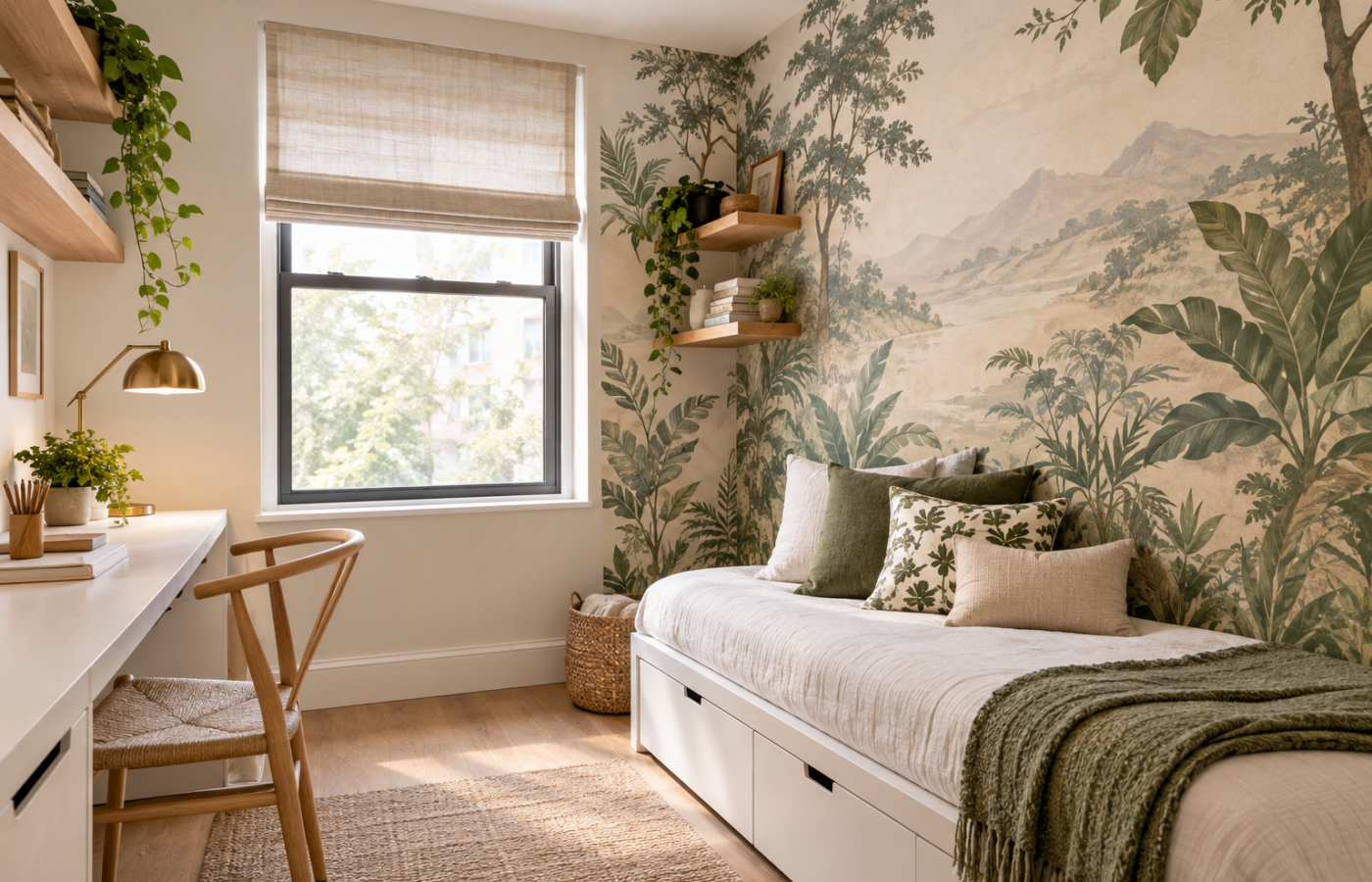
Unlike a repeating pattern, a mural is one continuous image printed across several panels, so the scene flows from edge to edge. Common styles include soft watercolor botanicals, misty mountain and forest landscapes, abstract washes of color, and vintage-style scenic views. For mural wallpaper for small rooms, calmer and softer images tend to work best.
Do: Choose a Single Wall
Limit the mural to one wall, usually the one you see first when you walk in or the one behind the bed or sofa. One mural wall gives the room a focal point while the other three stay quiet. Covering every wall in a small room usually feels closed in.
Don’t: Pick a Busy Image With Lots of Small Detail
Crowded, high-contrast scenes can feel restless in a compact space. Choose an image with open areas, soft transitions and one clear focal point. Landscapes with a distant horizon are especially good, because they create the illusion of depth and are among the most reliable mural wallpaper for small rooms.
Do: Use Light, Airy Colors
Pale greens, soft blues, warm creams and misty grays keep a small room bright. Dark, moody murals can work too, but they need good lighting and a sense of commitment. If you’re unsure, go lighter, since it is much easier to add drama later than to lighten a room that feels heavy.
Don’t: Ignore the Size of the Wall
Measure carefully and check how the image is cropped. A mural designed for a wide wall can lose its focal point when trimmed for a narrow one. Many suppliers let you enter your wall dimensions so the image is scaled properly, which is important for mural wallpaper for small rooms where every inch counts.
Do: Keep Furniture Simple
When the wall carries a lot of visual interest, the furniture in front should stay quiet. Solid upholstery, light wood and minimal decor let the mural take the lead, which is the styling rule behind almost every good example of mural wallpaper for small rooms. The same idea shows up in a well planned small living room, where fewer, better pieces make the space feel bigger.
Don’t: Hang Heavy Art on Top
Adding a large gallery wall over a mural competes with the image and hides the scene you paid for. If the wall needs something, add a simple mirror, a shelf or a single lamp nearby, and let the mural stay visible.
Do: Consider Peel and Stick for Rentals
Peel-and-stick mural panels are an easy way to try the trend without commitment, and they come off cleanly when you move out. If you’re new to the format, this guide to peel and stick wallpaper covers the application steps and removal tips that also apply to murals.
Where Mural Wallpaper Works Best in a Small Home
The bedroom headboard wall is the classic spot, since the mural sits behind the bed and you rarely block it. A small entryway benefits from a scenic wall that welcomes guests, a dining nook feels bigger with a soft landscape, and a home office wall can add calm behind a video call. Among all mural wallpaper for small rooms, the headboard wall is usually the safest first choice.
Doing This as a Renter
Check your lease first, but most peel-and-stick murals are designed to be removed without damage when applied to properly painted, smooth walls. Test a small hidden corner before you commit to the full wall, and keep the leftover panel scraps in case a section needs replacing.
Budget and Timing
Printed mural wallpaper typically costs from about $80 to $300 for a standard wall, depending on size and material, and peel-and-stick options are often at the lower end. Installation usually takes a few hours for one wall, longer if you’re working alone. Custom-sized murals may take a week or two to arrive, so plan ahead.
Where to Start If This Is Your First Time
Start with one small wall in a low-traffic room, such as a bedroom, a reading nook or a hallway. Order a sample first if the supplier offers one, so you can check the color in your own light. A small trial makes it easier to decide whether you want to go bigger later with mural wallpaper for small rooms.
Common Mistakes to Avoid
- Choosing the image before measuring the wall. Always confirm the panel size and crop first.
- Using a very dark mural without enough light. A dark scene needs good lamps and a window to stay comfortable.
- Skipping wall prep. Dust, texture and uneven paint show through and cause peeling.
- Adding too many patterns. With a mural on the wall, keep rugs, pillows and curtains simple.
FAQs
Does mural wallpaper make a small room look smaller? Not if you choose it well. A soft, light scene with open space and a distant horizon can make a small room feel deeper.
Can I use mural wallpaper for small rooms in a rental? Yes. Peel-and-stick murals are made for this, but check your lease and test a small area first.
What size wall works best? Almost any wall works if the image is scaled to your measurements, but a single unbroken wall gives the best result.
Is mural wallpaper hard to install? Peel and stick panels are beginner friendly, though matching the panels edge to edge takes patience and a level.
What colors are best for a small room mural? Soft greens, blues, creams and warm neutrals keep a small room bright and calm.
How much does a mural cost? Roughly $80 to $300 for one wall, depending on the material and how custom the size is.
Tools Worth Having Before You Start
A tape measure, a level, a smoothing tool, a sharp utility knife and painter’s tape cover most installations. A step stool helps reach the top of the wall without stretching, and a second person makes it far easier to hold long panels straight.
How Mural Wallpaper Compares to Painting a Mural
Hand painting a mural takes skill, time and paint, and it is hard to undo. Wallpaper murals give a similar effect in a fraction of the time and can be changed or removed later. For most people, mural wallpaper for small rooms is the more practical choice, especially in rentals where repainting isn’t an option.
The Bottom Line
The best mural wallpaper for small rooms sticks to one wall, uses soft colors and open space, and keeps everything else in the room simple. Get the scale right, prep the wall well, and a single scenic wall can give a small room the depth and personality it has been missing.
Related:
Peel and Stick Wallpaper Ideas for 2026: Easy Details for Renters · 22 Living Room Ideas That Make a Small Space Feel Bigger