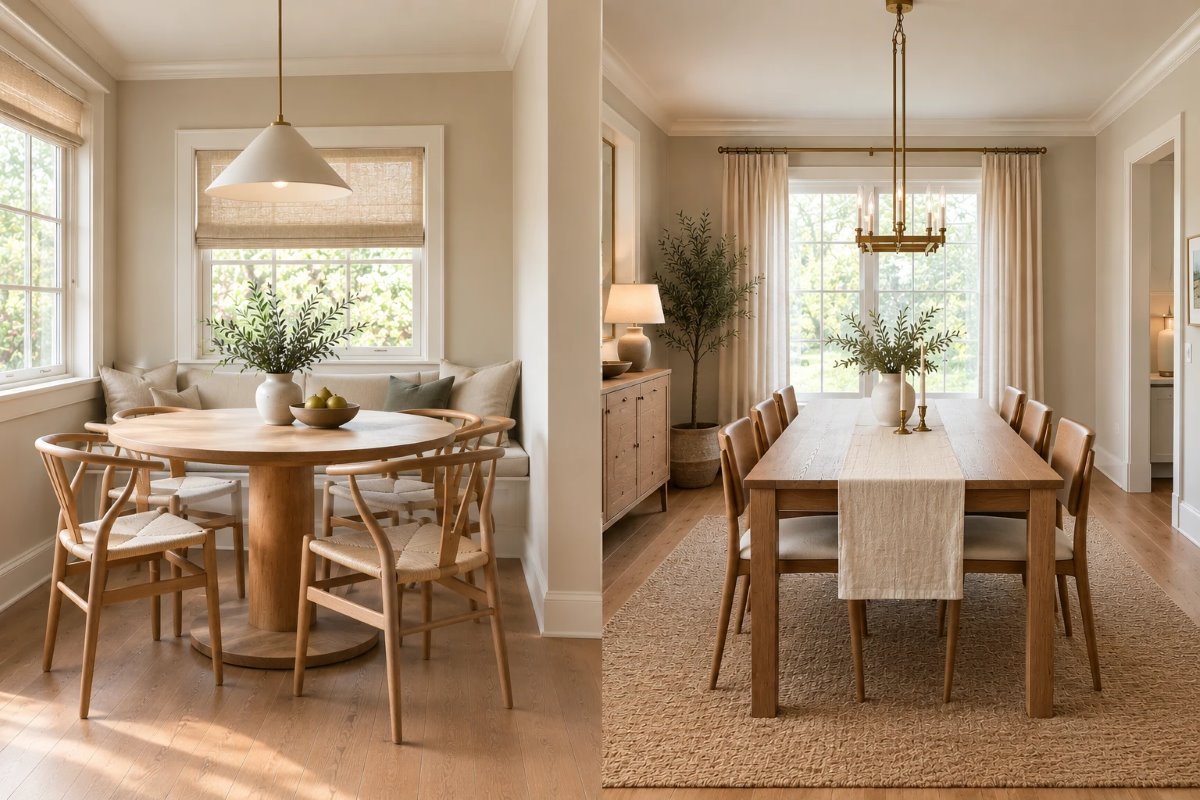
The shape of your dining table changes how a meal feels. A round table feels close and chatty, and a rectangular table feels formal and ready for a crowd. The round vs rectangular dining table decision comes down to five checks: conversation, seating, room shape, clearance and style.
This guide compares them on those five checks and gives tips for small rooms, benches, rugs and lighting. Most guides come from furniture sellers, so I treat their advice as general direction and flag the numbers as rules of thumb.
Quick Answer: Round vs Rectangular Dining Table
- Round: better for conversation, small rooms and about 4 to 6 regular diners.
- Rectangular: better for larger groups, long or narrow rooms and formal dinners.
- Oval: a middle option that seats more than a round table in a similar space.
- Clearance: leave about 30 to 36 inches around any table.
- Easy pick: round for a small, social room; rectangular for a long room or big gatherings.
What Each Shape Is
A dining table can be round, rectangular, square or oval. A round table has no corners and no head, so everyone sits about the same distance from each other. A rectangular table has two long sides and two ends, which suits long rooms and larger groups. In the round vs rectangular dining table decision, those two shapes lead to quite different dinners.
The 5 Checks at a Glance
| Check | Round | Rectangular |
|---|---|---|
| Conversation | Everyone about equal distance | Ends can feel far away |
| Seating | Best for 4 to 6; large sizes feel distant | Scales to 6 to 10 or more |
| Room shape | Square rooms, nooks | Long or narrow rooms |
| Clearance | No corners to bump | Corners need space |
| Style | Casual, intimate | Formal, classic |
Conversation and Seating
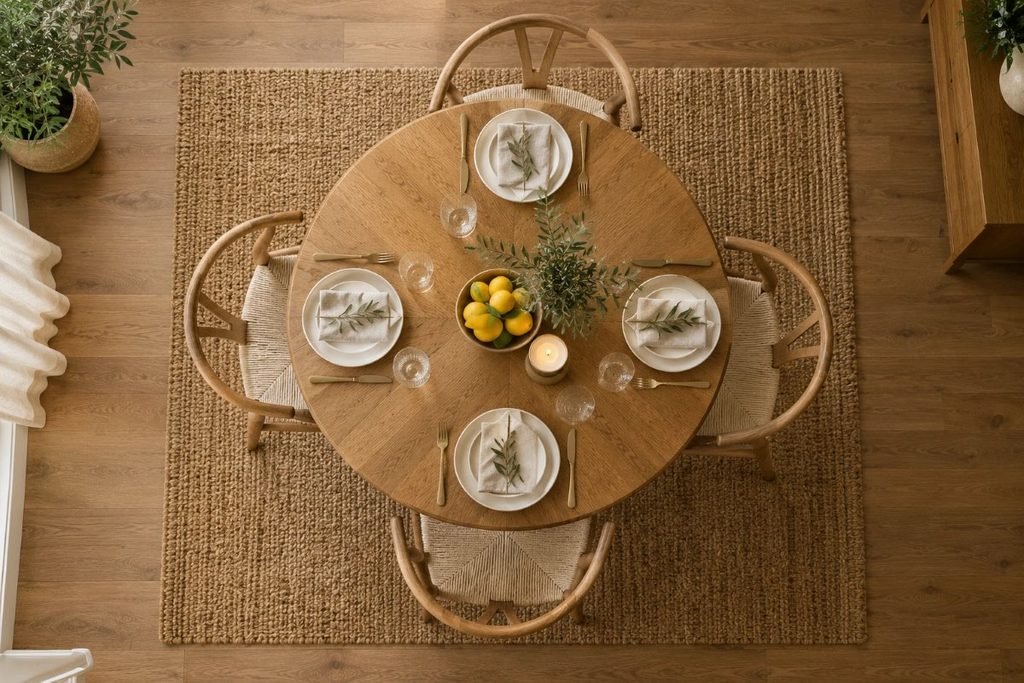
A round table puts everyone about the same distance apart, which helps conversation and feels intimate. Once a round table gets large, guests drift apart and the middle is hard to reach. A rectangular table seats more people comfortably and works for larger gatherings, but the people at the ends can feel distant from the conversation. Think about how many people you usually seat when you weigh a round vs rectangular dining table.
Room Shape and Layout
Round tables suit square rooms and tight spots such as kitchen nooks, because they have no corners. Rectangular tables suit long or narrow rooms, since they follow the shape of the room. One guide argues that round tables can seat more people than rectangular ones in a given space, which goes against the common assumption, so test your own room.
Small and Narrow Rooms
In a small room, a round pedestal table is easy to walk around and fits tight spaces, and a slim rectangular table against a wall can save space too. Our guide on how to arrange a small dining room shows layouts for both. Leave about 30 to 36 inches around the table so chairs can be pulled out.
Seating and Benches
A rectangular table pairs well with a bench along one side, which squeezes in extra seating. A round table is harder to pair with a bench, unless the bench is against a wall. See our guide to dining room bench seating for how to use a bench well. Chairs without arms tuck in neatly under either shape.
Rugs and Lighting
Choose a rug that extends at least about 24 inches beyond the table edge, so chairs stay on it when pulled out; our jute rug dining table size guide covers the sizing. A round table suits a round rug and a single pendant, and a rectangular table suits a rectangular rug and a linear light or two pendants; see our guide to pendant light size over a dining table. Matching the shapes makes the round vs rectangular dining table choice look planned.
Style and Mood
A round table feels casual, intimate and friendly, like a family kitchen. A rectangular table feels classic and formal, like a dinner party. Both can be styled up or down with chairs, linens and lighting. A pedestal base gives more legroom than four legs, on either shape.
Which Should You Choose?
Choose round if your room is small or square, you have 4 to 6 regular diners and you like intimate conversation. Choose rectangular if your room is long, you host larger groups or you prefer a formal look. If you cannot decide, consider an oval table, which seats more than a round one in a similar space. For a round table that seats six, a diameter of about 54 to 60 inches is the usual range.
Extending and Flexible Tables
If you host occasionally, look for an extending table. A round table with a leaf becomes an oval, and a rectangular table with leaves seats more. Check that the table still fits the room when extended.
Doing This as a Renter
Renters can choose a freestanding pedestal table that is easy to move, and use felt pads to protect floors. A folding or drop-leaf table is useful in a small rental. Choose a shape that suits the room you have, not the one you hope for.
Budget and Timing
Prices vary by size and material, and round tables with pedestals can cost the same as rectangular ones, so check current costs. A secondhand table is a good way to test a shape. Order after you tape out the table on the floor.
Where to Start If This Is Your First Time
Cut paper or tape the shape on the floor at the size you want, and place your chairs around it. Walk around it and sit down. If the walkway feels tight, go smaller or switch shape. This is the easiest way to test a round vs rectangular dining table before you buy.
Quick Recap
Round suits small, social rooms and 4 to 6 diners; rectangular suits long rooms and larger gatherings. Leave 30 to 36 inches around the table, match the rug and light to the shape and test with tape. The round vs rectangular dining table choice is about your room and your guests.
Living With Each Shape
A round table is easy to walk around and has no corners for kids, but it can feel too large if you add leaves. A rectangular table is easy to line up with a wall and a rug, but the corners need clearance. When you live with a round vs rectangular dining table, the daily feel matters more than the first impression.
Common Mistakes to Avoid
- Choosing a table too large for the room.
- Forgetting chair clearance.
- Choosing a round table for ten people.
- Skipping a tape test.
FAQs
Is a round or rectangular table better for a small room? Round is the usual pick for a small, square room.
Which seats more people? Rectangular scales better for larger groups.
Is a round table better for conversation? Yes, everyone is about the same distance apart.
What about an oval table? It is a middle option that seats more than a round one.
How much space around a table? About 30 to 36 inches.
Can I use a bench with a round table? Only against a wall.
Tools and Basics to Gather
A tape measure, painter’s tape or paper, a notebook, your chairs and a helper. Measure the room, the doorways and the path into the dining room before you order.
The Bottom Line
The round vs rectangular dining table choice is simple: round for small, social rooms and 4 to 6 regular diners, and rectangular for long rooms, larger groups and formal dinners. Tape out the shape first, leave 30 to 36 inches around it and match the rug and light. Done that way, your table will suit both your room and your guests.
Related:
How to Arrange a Small Dining Room · Jute Rug Dining Table Size Guide