If you work from home but have no spare room, look at your closet. A closet home office, sometimes called a “cloffice,” turns a few square feet of unused space into a place that is just for work. It has walls on three sides, which helps you focus, and when the workday ends you can close the door or draw a curtain and leave the work behind.
These six steps show how to plan a closet home office, from measuring and clearing to power, lighting and storage, along with renter-friendly options.
Why a Closet Makes a Good Office
A closet is already a quiet, contained space, with walls that block distractions and a shape that suits a small desk. It also keeps work out of the rest of the room, which many people find helpful in a studio or a shared bedroom. A closet home office costs far less than a renovation and can be set up in a weekend.
The idea works best in a closet that is at least about two feet deep, and a walk-in closet or a wide reach-in closet is even better. Sit on a chair in the space with a laptop to see if it feels comfortable before you commit.
Step 1: Measure and Empty the Closet
Measure the width, depth and height of the closet. A desk surface usually needs a depth of around 20 to 24 inches and a width of at least 30 to 36 inches for a laptop and a notebook. Take out clothes, shoes and boxes, and decide where they will go. Sorting the closet is often the hardest part of building a closet home office, so plan an afternoon for it.
Step 2: Remove the Doors or Change Them
Standard closet doors can block the desk area. You can lift off sliding or bifold doors, or replace them with a curtain on a tension rod, which is easy and renter-friendly. If you keep the doors, choose ones that fold fully out of the way. A curtain in a warm fabric also makes the closet look like a deliberate nook instead of a storage space.
Step 3: Build or Place the Desk
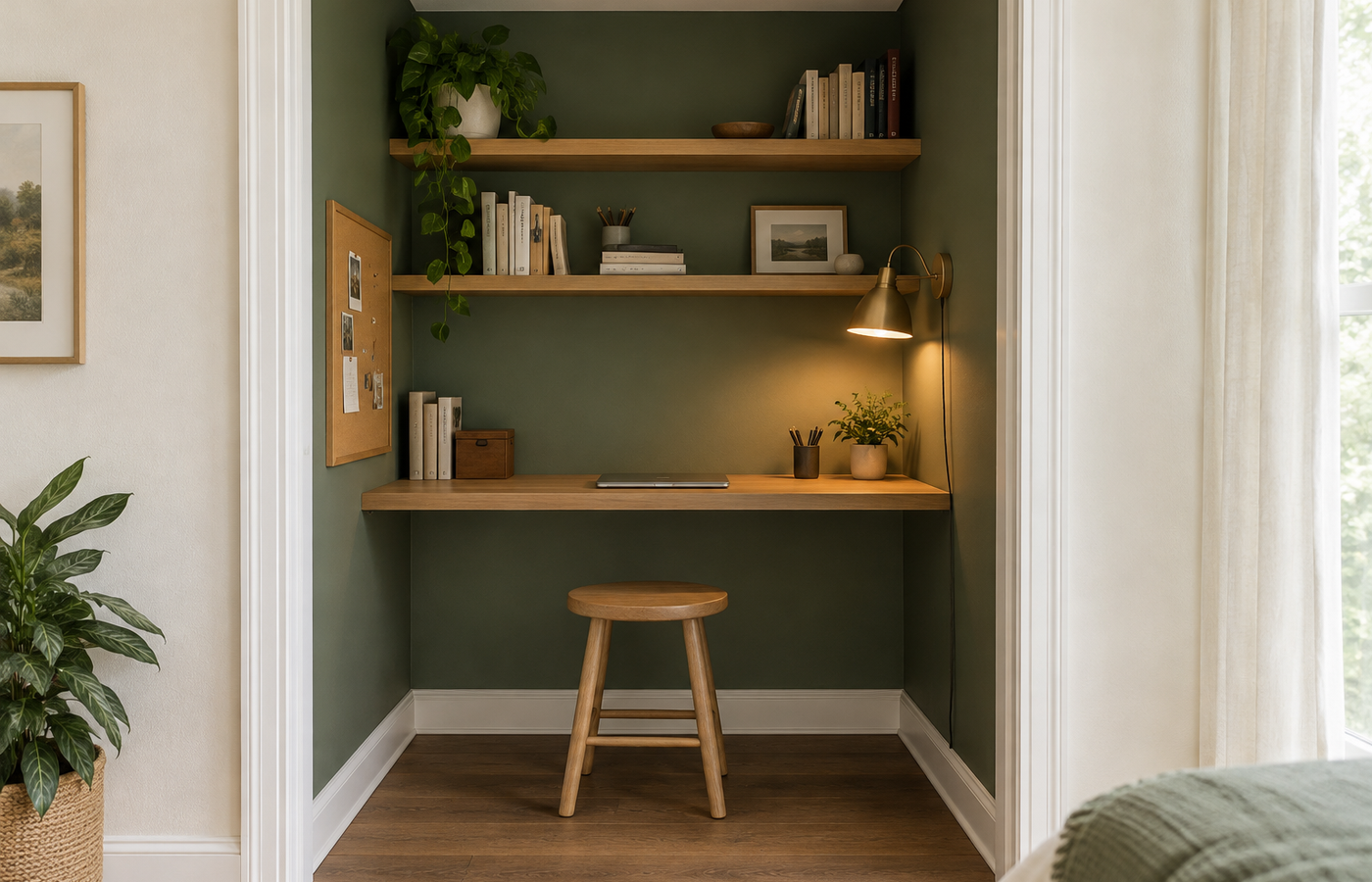
There are three simple options. A floating shelf mounted at desk height works well if your lease allows drilling. A butcher block or wood board on two small supports is easy to build. A slim freestanding desk that fits the width needs no installation at all and moves with you. A desk height of around 28 to 30 inches suits most chairs. Keep the surface clear, so the closet home office does not feel crowded.
Step 4: Add Power Safely
Many closets have no outlet. Use an extension cord or a power strip with surge protection from the nearest outlet, run along the wall edge and secured with cord clips. Do not run cords under rugs, and do not overload a strip. If you want a permanent outlet, ask a licensed electrician to add one, since closet wiring should not be a DIY project.
Step 5: Layer the Lighting
Closets are often dark. Use a small plug-in wall sconce, an LED strip light under a shelf or a compact desk lamp. LED bulbs stay cool, which matters because closets hold fabrics, and bulbs should be kept well away from clothing and boxes. Warm bulbs, generally 2700K to 3000K, make the space feel cozy, and a slightly cooler bulb can help during long focus sessions.
Step 6: Organize the Walls and Shelves
The walls are your storage. Add floating shelves above the desk for books and supplies, a corkboard or pegboard for notes, and hooks for headphones and a bag. Keep the top shelf of the closet for boxes and files you rarely need. Baskets and small bins keep cables and chargers neat. A well-organized closet home office feels calm, and it helps you focus.
Add Color and Personality
Because the space is small, you can be bold. Paint the inside a deep green, navy or terracotta, or use removable wallpaper. Our guide to peel and stick wallpaper explains how to add a pattern without paint. A plant, a framed print and a warm rug on the floor outside give the nook a finished look.
Choose the Right Chair
A closet has little room for a large office chair. Choose a slim task chair, a small wooden chair with a cushion or a stool that tucks fully under the desk. Make sure your elbows and wrists are comfortable, and take breaks to stand and stretch. A comfortable chair is the most important part of a closet home office you will use every day.
Sound and Video Calls
A closet is a good place for calls, since the clothes and walls absorb sound. If the closet is empty, add a small rug, a curtain and a few soft items to reduce echo. Check the background you show on camera, and keep it tidy. For more ideas about desk layouts and small work areas, see our guide to setting up a home office for small spaces.
Doing This as a Renter
Almost everything here is reversible. Use a curtain on a tension rod instead of removing the doors, choose a freestanding desk or one that rests on brackets you can take down, use plug-in lights and removable wallpaper. Keep the original doors stored safely so you can put them back at move-out.
Budget and Timing
You can build a basic closet home office for under $150 with a desk board, a lamp and a few shelves. Adding paint, a good chair and organizers raises the cost a little. Most of the work fits into a weekend, including sorting the closet.
Where to Start If This Is Your First Time
Test the space first. Set up a laptop on a board or a small table in the empty closet and work there for a few days. This shows you whether the light, the temperature and the size suit you before you spend money.
Common Mistakes to Avoid
- Ignoring airflow. Closets can get warm, so leave the door or curtain open while you work.
- Overloading a power strip. Use surge protection and do not overload it.
- Keeping bulbs near fabric. Use LED lights and keep clothing away from them.
- Choosing a chair that does not fit. Test it before you buy.
FAQs
Can any closet become an office? Most closets that are about two feet deep or more can work, especially walk-in or wide reach-in closets.
Do I need an electrician? Only if you want a permanent outlet. Otherwise, a surge-protected power strip is enough.
How do I keep it from overheating? Leave the door or curtain open, keep the space clear and use cool LED lights.
Is it good for video calls? Yes, a closet absorbs sound and gives a neat background.
Can renters do this? Yes, with a curtain, a freestanding desk and plug-in lights.
Where do the clothes go? Move them to another closet, a rolling rack or under-bed bins.
Tools and Basics to Gather
A tape measure, a level, a small drill if your lease allows drilling, cord clips, a surge-protected power strip, a lamp or LED strip, a desk board or small desk and a chair are enough for most closet projects.
Keeping It Focused
A closet home office works because it is small and clear. Keep only what you need at hand, close the curtain at the end of the day and avoid using the space for anything except work. That simple boundary makes it easier to focus during the day and to switch off in the evening.
The Bottom Line
A closet home office gives you a real place to work without a spare room. Measure the closet, change or remove the doors, add a desk, power and lighting, organize the walls and add a little color. Start with a test run, keep safety in mind, and turn a forgotten space into the most useful corner of your home.
Related:
Peel and Stick Wallpaper Ideas for 2026: Easy Details for Renters · How to Set Up a Home Office: 7 Easy Wins for Small Spaces