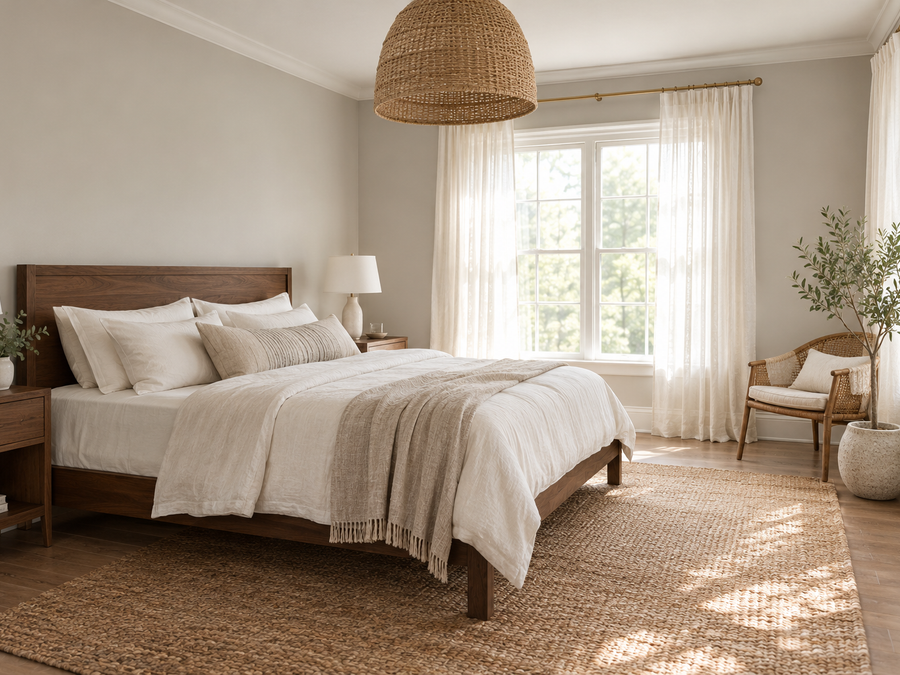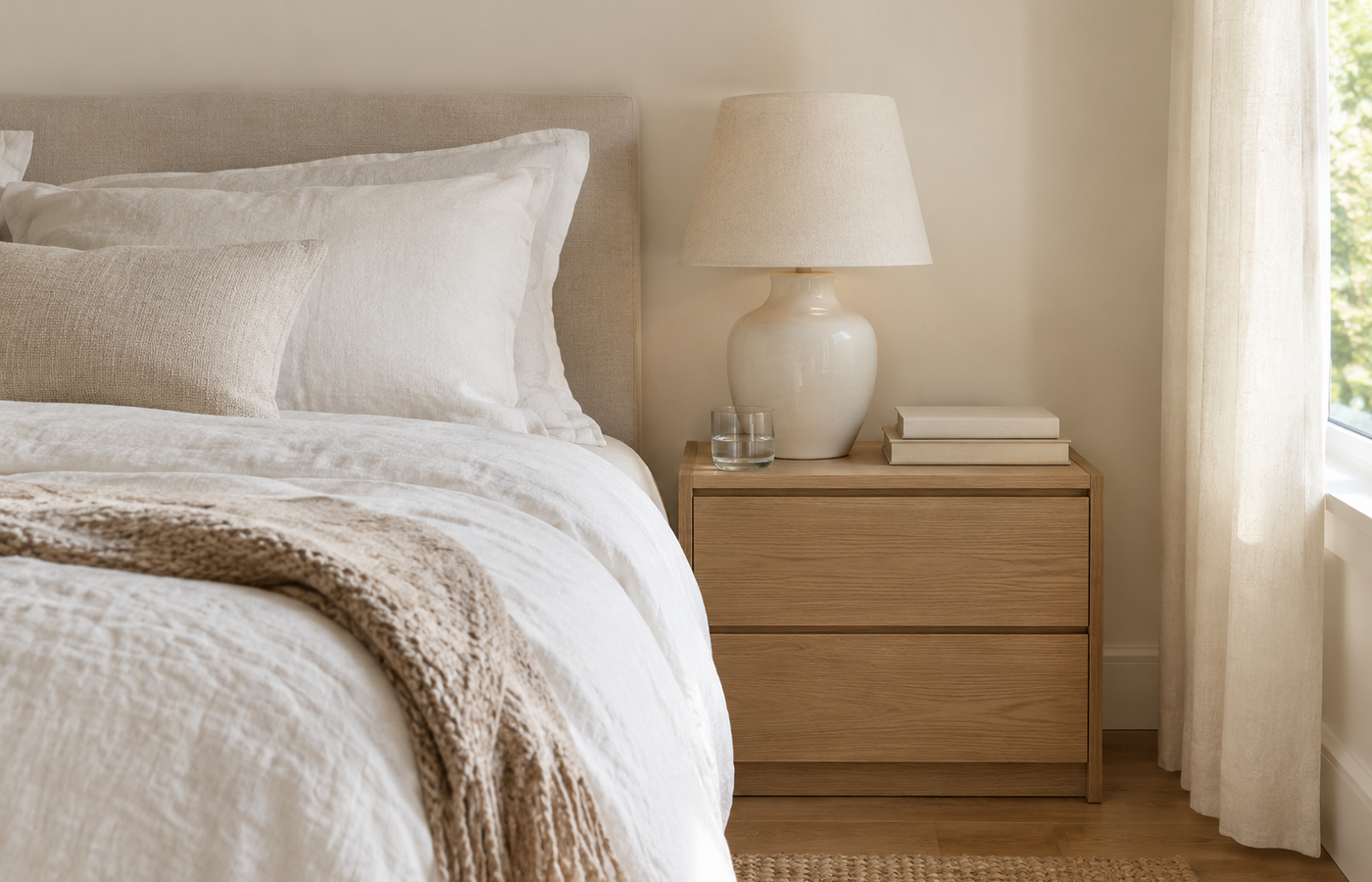
A nightstand that is too low makes you bend for your phone, and one that is too tall makes you reach up for a glass of water. The fix is simple. When you compare nightstand height vs mattress height, the target is a tabletop within about two inches of the top of your mattress.
This guide gives you the rule, a quick height chart, how to measure your bed, and fixes for small rooms, tall beds and low beds.
Quick Answer: Nightstand Height vs Mattress Height
- The rule: keep the nightstand top within about 2 inches above or below the mattress top.
- Safe range: level with the mattress up to about 2-4 inches higher.
- Typical nightstands: about 22-28 inches tall, with 24-26 inches most common.
- Measure: floor to the top of the mattress, including any topper.
- Lower beds: choose a lower nightstand or a wall shelf.
Why the Height Match Matters
A mattress and the table beside it work together. When the heights match, your hand moves sideways from the bed to the tabletop instead of dipping down or stretching up. That’s why nightstand height vs mattress height matters more than the style of the table. It also affects lamps: a lamp on a nightstand that is too low can leave the light under your eye level.
How to Measure
Make the bed as you normally sleep in it, with the mattress topper and bedding. Measure from the floor to the top of the mattress at the edge. That is your target. Then add up to about 4 inches if you like a slightly higher table, and subtract nothing more than 2 inches if your bed is tall. Write down the number before you shop.
Height Chart
Here are the numbers using the 2-inch rule, as a starting point:
| Mattress top (floor to top) | Nightstand range (within 2 in) | Good fit |
|---|---|---|
| 20 in (low platform bed) | 18-22 in | Low table or wall shelf |
| 22 in | 20-24 in | Standard low nightstand |
| 25 in | 23-27 in | Most common nightstands |
| 28 in (tall bed) | 26-30 in | Tall nightstand or stacked table |
Treat these as rules of thumb. A nightstand a little higher than the mattress is usually fine; one much lower is the most annoying.
Low Beds and Platform Beds
Low beds often sit around 18-22 inches. A standard 26-inch nightstand will tower over them. Look for low tables, floating shelves or wall-mounted tables that you can hang at the right height. A small stool or a basket also works if you only need a place for a lamp and a glass.
Tall Beds and Adjustable Bases
Tall beds and thick mattresses can reach 28 inches or more. If a nightstand tops out at 28 inches, choose the tallest option you can find, or stack a low table with a sturdy tray. If you use an adjustable base that raises the head of the bed, keep the nightstand at the flat-bed height so it works in both positions.
Small Bedrooms and Tight Spaces
In a small room, a slim nightstand or a wall shelf saves floor space. Our guide to how to arrange furniture in a small bedroom shows how much clearance to leave beside the bed, and more small bedroom ideas cover tricks for tight layouts.
Bedside Lamps and Outlets
The lamp matters as much as the table. A lamp with a shade bottom around eye level when you sit up in bed gives good reading light without glare. Make sure an outlet is within reach, and keep cords tucked behind the nightstand. For tight spots, wall sconces free up the tabletop entirely.
Choosing a Nightstand on a Budget
You don’t need a matching set. A secondhand dresser, a small bench or a stool can work if the height matches. For more low-cost ideas, see our guide to cozy bedroom ideas on a budget.
Style Ideas
Match the nightstand to the room’s style: simple oak or pale wood for calm, minimal rooms like our Scandinavian bedroom ideas, metal or glass for modern rooms, and painted wood for farmhouse looks. Two mismatched nightstands can look charming if their heights are close.
Doing This as a Renter
Renters can use freestanding tables or clamp-on shelves. A stack of sturdy boxes with a cloth is a quick temporary fix. If you drill a floating shelf, check with your landlord first.
Where to Start If This Is Your First Time
Measure the mattress top, write down the 2-inch range, and then compare it to the nightstand’s listed height. If you’re buying online, add the legs and any adjustable feet to the number.
Nightstand Size and Spacing
Height is only half the story. A nightstand should also be wide enough for a lamp, a glass and a book, and shallow enough to leave a comfortable walkway. When you compare nightstand height vs mattress height, check the footprint too, especially in a small room where every inch counts. Leave enough space so you can open drawers fully and get in and out of bed without bumping the table.
Storage and Styling the Top
Keep the top simple: a lamp, a small tray for essentials and one personal item. If the nightstand has a drawer, use it for chargers and reading glasses so the surface stays clear. A shelf below holds books or a basket. Even if nightstand height vs mattress height is perfect, clutter will make the table feel awkward to use at night.
Wall-Mounted and Floating Options
A floating nightstand can be hung at exactly the right height, which makes it ideal for low beds, platform beds and tight rooms. Measure from the floor to the mattress top, mark the wall and use anchors rated for the weight, fastened into studs where possible. Check for wires and pipes before drilling.
A Quick Test Before You Buy
Cut a piece of cardboard to the nightstand’s height, stand it beside the bed and sit down as you would at night. If your hand falls naturally onto the top, the nightstand height vs mattress height is right. This takes one minute and avoids returns.
Quick Recap
Measure the mattress top with the topper on, aim for a tabletop within about two inches, and check the footprint and drawers. Nightstand height vs mattress height is the single most useful number to know before you buy.
Common Mistakes to Avoid
- Measuring the bed frame instead of the mattress top.
- Forgetting the mattress topper or thick bedding.
- Buying by style before checking nightstand height vs mattress height.
- Choosing a table much lower than the mattress.
FAQs
How tall should a nightstand be compared to the bed? About level with the mattress top, within roughly 2 inches above or below.
What is the standard nightstand height? About 22-28 inches, with 24-26 inches most common.
Can a nightstand be higher than the mattress? Yes, a few inches higher is usually fine; much lower is the problem.
What if my bed is very low? Use a low table, a stool or a wall shelf.
Do I measure with the topper on? Yes, measure the top of the mattress with the topper on.
Should both nightstands match? Not necessarily, but their heights should be close.
Tools and Basics to Gather
A tape measure, a notebook or phone, and the listed heights of the nightstands you’re considering. If you hang a shelf, add a level and a stud finder.
The Bottom Line
Nightstand height vs mattress height comes down to one easy rule: keep the tabletop within about two inches of the top of your mattress. Measure with your topper on, check the chart, and choose a low table or shelf for low beds. Get that right and everything at your bedside is within easy reach.
Related:
20 Cozy Bedroom Ideas on a Budget (Most Under $200) · How to Arrange Furniture in a Small Bedroom