Shop for dining room storage and you will see the same long, low cabinet called a sideboard on one site, a buffet on another and a credenza on a third. The names overlap so much that it is easy to buy the wrong height or style for your room. The sideboard vs buffet vs credenza question gets much simpler once you know the few real differences that matter.
This guide explains what each piece usually is, how they compare on height, legs and use, and three easy questions that tell you which one suits your dining room, plus sizing, placement and the common mistakes to avoid.
Quick Answer: The Short Version
- Sideboard: a long dining room cabinet with drawers and cupboards, usually about 34 to 38 inches tall, on short legs or a solid base.
- Buffet: almost the same as a sideboard, often on taller legs, used mainly as a serving surface.
- Credenza: lower and sleeker, often 20 to 36 inches tall, with short or no legs, used in living rooms, offices or under a TV.
- The easy rule: choose a buffet or sideboard for serving, and a credenza when you want a low, modern look.
Are They Really Different?
Honestly, only a little. Even the sideboard entry on Wikipedia notes that a sideboard is also called a buffet and that the two words are somewhat interchangeable. Furniture brands use the names loosely, so the label on a product page is less important than its height, legs and storage. Treat the sideboard vs buffet vs credenza labels as a rough guide, then judge each piece by the details below.
The Comparison Table
Here is the sideboard vs buffet vs credenza comparison at a glance. These are typical ranges from furniture-retailer guides, so always check the exact measurements of the piece you are buying:
| Feature | Sideboard | Buffet | Credenza |
|---|---|---|---|
| Typical height | About 34-38 in | About 34-38 in | About 20-36 in |
| Legs | Short legs or solid base | Usually taller legs | Short legs or none |
| Main room | Dining room | Dining room | Living room, office |
| Best for | Storage and serving | Serving food | Low storage, TV, display |
What a Sideboard Is
A sideboard is the all-rounder. It usually has a mix of drawers for cutlery and linens and cupboards for plates, platters and glassware, with a long top that works for serving or display. Because it sits close to the ground on short legs or a plinth, it feels solid and holds a lot. In the sideboard vs buffet vs credenza debate, the sideboard is the safest choice when you want one piece that stores and serves equally well.
What a Buffet Is
A buffet is the dining room piece built mainly for serving. It often stands on taller, more visible legs, which lifts the top to a comfortable height for setting out dishes and makes the piece feel lighter. Traditional buffets can be long and more formal. If you host often and want a dedicated place to lay out food, drinks or a dessert spread, a buffet is the natural pick.
What a Credenza Is
A credenza is the lowest and usually the most modern of the three. It often has sliding or flat doors, short legs or none, and a long horizontal shape. Credenzas started in offices and are now common in living rooms as media consoles. In a dining room, a credenza works well under a window or a large piece of art, where a taller cabinet would block the view.
Question 1: Will You Serve From It?
The first sideboard vs buffet vs credenza question is about serving. If you plan to put food on it during dinners, choose a sideboard or buffet at about counter-to-table height, so dishes are easy to reach while standing. A low credenza makes serving awkward, since everyone has to bend down. If the top will only hold lamps, a plant and a bowl, height matters much less.
Question 2: How Much Space Do You Have?
This is where the sideboard vs buffet vs credenza choice often gets decided. Measure the gap between the wall and the back of your dining chairs when they are pulled out. A common rule of thumb is to leave about 36 inches behind chairs where nobody needs to pass, and closer to 44 to 48 inches where people walk behind seated diners. Subtract the cabinet’s depth from that space before you buy. In a tight room, a slim, shallow sideboard is easier to live with than a deep buffet, so compare depths closely. Our guide on how to arrange a small dining room covers more layout tricks for tight spaces.
Question 3: What Style Is Your Room?
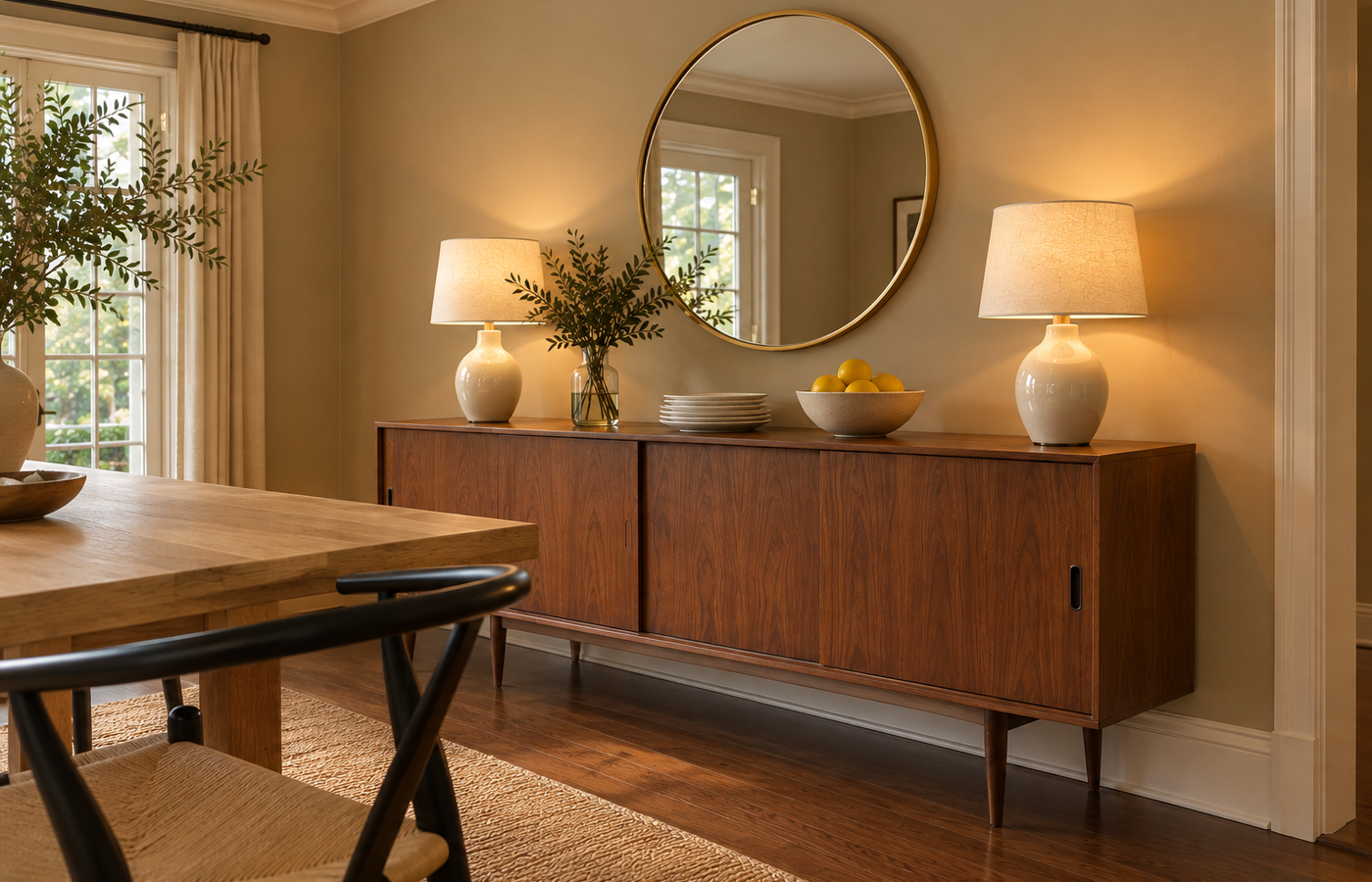
Style settles many sideboard vs buffet vs credenza choices. A traditional or country dining room suits a wood sideboard or a buffet with turned legs. A mid-century or modern room suits a walnut sideboard on tapered legs or a low credenza with sliding doors. A Scandinavian or Japandi room suits pale oak and simple fronts. Match the leg style to your dining chairs and the piece will look planned rather than added later.
Sizing It to the Wall and Table
Whichever way the sideboard vs buffet vs credenza choice goes, keep the cabinet shorter than the wall it sits on, with some bare wall on each side, and aim for a length that feels in proportion to your dining table. A piece that is much longer than the table can overwhelm the room, while one that is too short looks lost on a long wall. Tape the outline on the floor and wall before you order.
Styling the Top
Keep the top useful and simple. A pair of lamps, a mirror or piece of art above, a bowl or plant and a small stack of plates is plenty. If you hang a mirror, the proportions in our guide to a mirror above a console table work just as well over a sideboard or buffet: aim for roughly two-thirds of the cabinet’s width.
Doing This as a Renter
Every piece in the sideboard vs buffet vs credenza lineup is freestanding, so all three are renter-friendly. Choose a piece that will also work in your next home, such as a credenza that can move to a living room as a media console. If you have small children or pets, use the anti-tip kit that comes with tall or heavy cabinets, and ask your landlord before drilling.
Budget and Timing
Flat-pack sideboards and credenzas are the most affordable, solid wood and vintage pieces cost more, and custom built-ins cost the most. Vintage and secondhand shops are a good place to find solid wood buffets at lower prices. Allow time for delivery and, for flat-pack pieces, a couple of hours to assemble.
Where to Start If This Is Your First Time
Measure the wall length, the space behind your chairs and the height of any windowsill or outlet on that wall. Decide whether you need a serving surface, then choose the type with the table above. Shortlist sideboard vs buffet vs credenza options that fit your measurements before you look at colors or finishes.
Common Mistakes to Avoid
- Trusting the product name. Check the actual height, depth and legs instead.
- Choosing a deep buffet for a narrow room. It blocks the walkway behind chairs.
- Buying a low credenza for serving. It makes reaching dishes uncomfortable.
- Skipping the anti-tip kit. Tall or heavy cabinets should be secured, especially around kids.
FAQs
What is the main difference in the sideboard vs buffet vs credenza question? Mostly height and legs: buffets and sideboards are taller and made for serving, while credenzas are lower and sleeker.
Is a sideboard the same as a buffet? They are very similar, and the names are often used interchangeably.
Can I use a credenza in a dining room? Yes, especially under a window or artwork, though it is less comfortable for serving.
How tall should a dining room sideboard be? Most sit around 34 to 38 inches, close to counter height.
How much space do I need behind dining chairs? About 36 inches as a minimum, and more where people walk behind seated diners.
Which is best for a small dining room? A slim, shallow sideboard usually works best in tight spaces.
Tools and Basics to Gather
A tape measure, painter’s tape to mark the outline on the wall and floor, a level for styling a mirror or art above, and the anti-tip kit supplied with the cabinet are all you need.
The Bottom Line
The sideboard vs buffet vs credenza choice is easier than the names suggest. Pick a sideboard for storage and serving, a buffet when serving is the main job, and a credenza when you want something low and modern. Measure your walkway, match the legs to your chairs, and let function, not the label, make the final call.
Related:
How to Arrange a Small Dining Room: 7 Easy Steps · Mirror Above a Console Table: The Easy Answer Is 2/3 Width